To wordpress. URL, for now, anyway is www.themerelyreal.wordpress.com. The current name, mostly a joke but not totally, is Campus Crusade for Bayes. That's an inside joke from my Secular Alliance, but you can probably figure it out. Bayes is important to me, and so is rationality, which is why the name is taken from this Less Wrong post: http://lesswrong.com/lw/or/joy_in_the_merely_real/. If you don't know less wrong, I'd check it out. The summary of this post is that the 'merely' real is both all there is and not mere at all. If we accept the second, we can accept the first without worrying that we are missing out. Which is important, if we want to be happy in this amazing universe we're in. Reality is a thing to be treasured.
The name might change, to Strange Matter or The Merely Real. It's not clear yet, but I'll update if there are any changes. The links will probably be screwy for a while, but I'm sure it will all work out.
Thanks for following me to this point, and please join me over at Campus Crusade for Bayes!
Tuesday, May 29, 2012


Thursday, May 17, 2012
In the Night Kitchen: Part 2
The project continues! I'm really enjoying this opportunity to reread a valued childhood book and rexamine it with fresh and overly analytic eyes. I hope to finish before the end of the week. Unlikely, I know,
but the goal remains. In case you don't know what I'm talking about, here's Part 1. Without further ado!
 |
| Page 5Source: Maurice Sendak |
I remember very little about my
reactions to this page as a child, which is understandable given that it serves
mostly as transition. I wonder a great deal about Sendak's choice of jams and
other kitchen objects, whether they are from his memory, or imagination, or
something else. I do want to point out the visual aspect of the text
"Mickey Oven" which evokes Disney, alluding to a darker side,
perhaps, of that other children's favorite, demonstrating with just a subtle
symbol that most children's fantasy is grimmer than it appears. The rhyming
and compound word "Mickey-cake" seem to come straight out of the
pat-a-cake rhyme game, reclaiming the excitement of a child at having a cake, a
real life physical object, marked with the name that signifies their identity
and in that marking becomes a part of the universe that is cordoned off just
for them. That world in which the cakes are all for you, brought into existence
by singing games, is the real-life analogue of the Night Kitchen, that
exotic but almost-close-enough-to-touch world where bakers make cakes for the morning,
cakes that are in fact, not only for you and named for you, but made of you,
too.
 |
| Page 6 Maurice Sendak |
Oddly, I don't remember this page
at all. Reading it now felt like reading it for the first time, and this first
time reader thought, look how empowered Mickey is! There is this fanciful world
in which the cakes are for you, but what if that's not what you want? What if
the conventional path laid out, in which things (clothes coming off, falling
into another world, being folded into a batter) simply happen to you, without
your say. What if, even though, because this is fantasy, you are delighted at
all of these lovely things, and there's nothing wrong with them at all, you
want to act? It remind me greatly of Knight's Castle, by Edward Eager, in which
the protagonist children become part of the world of their knights and dolls,
and occasionally things go quite dangerously awry. The way to get out of the
danger is to remind yourself that it is fantasy and not real, and , there is a
scene in Knight's castle in which Ann, the youngest child, petulantly cries out
the words that end the magic, and while the other children are upset with her,
it is her way of asserting herself and her power over the events transpiring
that affect her. Similarly, Mickey is defiant, changing the course of the
story, disturbing the calm, nightly patterns of the bakers, and proudly
stating, "I'm not the milk and the milk's not me! I'm Mickey!" There
will be no denial of identity in Maurice Sendak's book, not like the polite
children in most children's literature, who could be replaced easily by their
counterparts in similar formulaic books. No, Mickey knows who he is, and
encourages readers, by example, to know who they are, too, and to shout it
unashamedly.
 |
| Page 7 Maurice Sendak |
This I remember. This I remember as
being a splendid set of instructions for any life task, as if if you only could
pound and pull and work enough, you could build anything, even a plane made of
bread dough. It's important, I think, that the bread dough was simply lying
around; it emphasizes the completeness of the Night Kitchen. It is not only a
vehicle for the story, but an entire world with characters and objects we
haven't necessarily heard about yet. In any fantasy story, the protagonist
meeting new characters from the world reminds the reader just how complex it
is, just how real it is, just how much there is to discover. It allows the
reader to consider the world as one to discover, rather than to create, a
beautiful fiction (since authors and readers do, in fact, together construct
these worlds) that lets us truly fall into the magic of fantasy.
Mickey's facial expressions are important here. He begins, as
he has been most of the story, idyllically tranquil, then
becomes frustrated and scared in the third panel. That's not
mentioned in the text at all, so we have to divine it for ourselves, noting
the brief uncertainty before sheer determination and talent set in.
After all, Mickey is no conventional protagonist. He is
not serendipitously perfect. He is in a world that is not of his
creation, and though his intent to escape is pure, he's not quite sure how to
do it. Soon enough, though, he devises a plan, and executes it. All the while
the background changes, showing us more and more of this strange world, even if
it doesn't quite accord with spatial physics.
 |
| Page 8 Source: Maurice Sendak |
And he does it! He succeeds in his
crazy plan and manages to fly, fulfilling the imaginations of countless
children. Two things of note on this page: the plane is neither purely nor
fully functional. That is to say, Mickey wants the plane to "look[]
ok", to have a decorative star, simply because he wants it
there. We notice that the mobile on the first page has something that could be
a star on it, but on the body instead of the wing. Secondly, the plane drops
pieces of dough as it flies, because Mickey isn't perfect, and neither are his
creations. What are a few pieces missing when you've just made a plane out of
nothing but bread dough and will?
The next page doesn't make any sense except in the context of
the flow of the plot, so I'll stop here for now. This is really great fun, and
I hope my readers (the few that there are) are enjoying it as well. It's so
nice to reminisce about great books.
Wednesday, May 9, 2012
In the Night Kitchen: Part 1
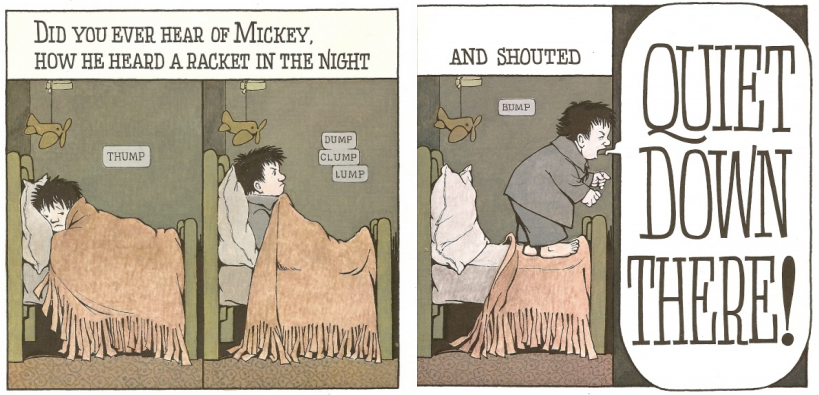
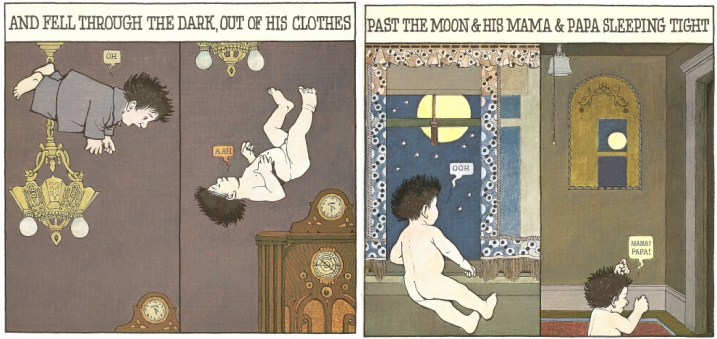
Though psychology has unequivocally swept away Locke’s theory of the tabula rasa, the blank slate with which we are born, in the imagination of children’s book authors, the minds of children are still sunny, white-washed and tranquil, disturbed only by the absence of food or a blanket, or the transient difficulties faced by a beloved character. But this is nothing more than an obsession with purity worming its way into our socializing processes. No adult knew better than Maurice Sendak that to be a child is to be constantly disturbed, bewildered and terrifying by an ever-changing landscape over which one has no control. Do other people have minds and thoughts? Where do my parents go when I don’t see them? What if the monsters are real? How much can I imagine? To be a children’s author is to work at remembering what it was like to be a child; an incredibly difficult procedure. It requires truly the best of minds to speak to the mad and wild complexities of internal life in language suitable for young ones.
My copy of In the Night Kitchen is sitting in my home in Miami, Florida, currently thoroughly unloved, though still showing signs of the tens of times I eagerly tore through it (not always figuratively) or asked that my parents do so aloud. In honor of Maurice Sendak, that brilliant, unconventional, controversial children’s writer, I am going to blog through a rereading of the book. The pdf is available online here, though the effect is far diminished when the pages are not in front of you, adamantly demanding attention with their glossy shine, intense colors and larger-than-your-head size. Follow along, and add your own recollections or thoughts in comments!
 |
| Cover Page. Source: Maurice Sendak |
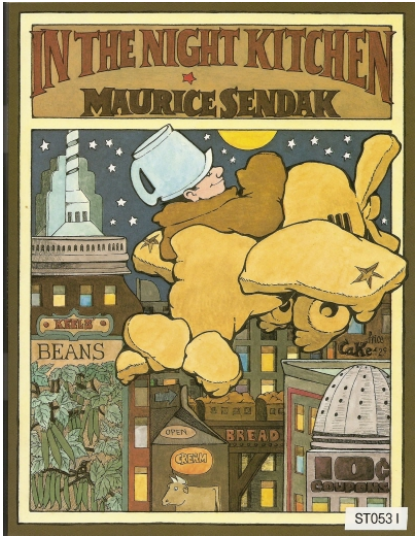
There are no bright colors. None. This is unheard of for a children’s book. There are greys, muted reds and greens, and a great deal of brown. The effect, frankly, is one of uneasiness, perhaps fear. The image of of our hero, flying in a clearly not airworthy vessel, with a facial expression of sheer contentment gives a sense of delicious fun (he’s wearing something on his head!) and delightfully contrasts with the dirty, grimy city below. And yet! What is this city but all the things one might find in a kitchen, alluding to all of the playful childhood imaginations of anthropomorphic household items. I certainly remember wishing I were small enough to see my house as a whole world, being absolutely certain that the vantage point of an ant or toy soldier would be infinitely more interesting.
 |
| Page 1 Source: Maurice Sendak |
 |
| Page 2 Source: Maurice Sendak |
 |
| Page 3 Source: Maurice Sendak |
 |
| Page 4 Source: Maurice Sendak |
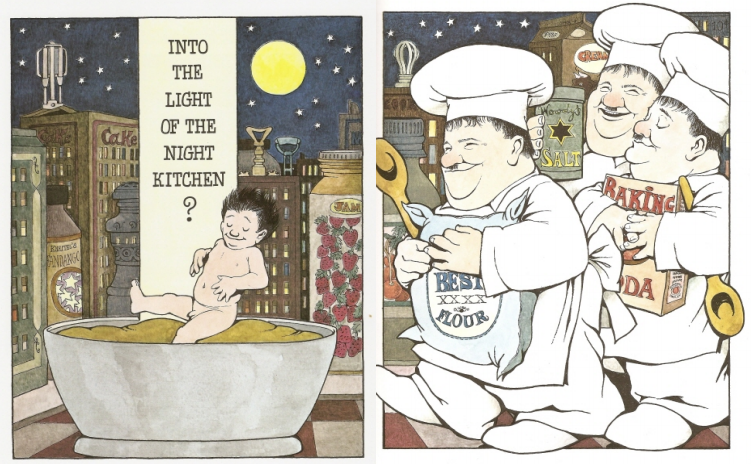
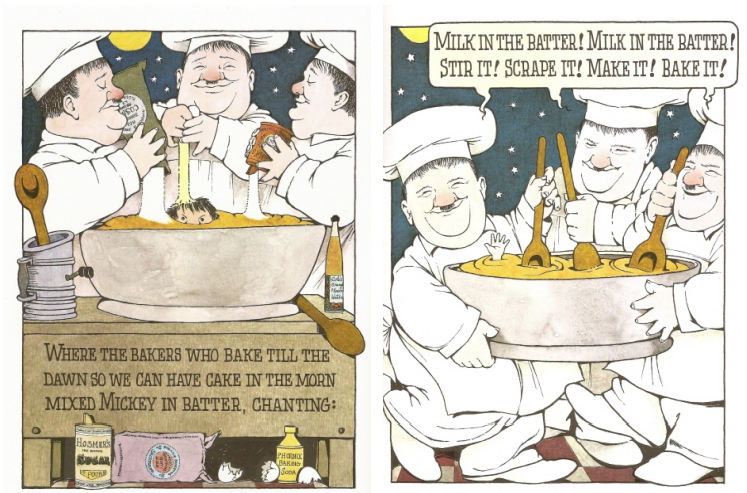
This, I think, is true genius. To understand that a world of strange creatures doing unbelievable things and having gripping adventures all the while comes second only to a world populated with people more or less like us, doing things more or less like us, just different enough to bewilder, who care not a whit for our existence.
There is also brilliance in the tension of the possibility of abject terror from being buried alive in hot batter existing side-by-side with the nonchalance of the everyday workings of a different world. Of course, this neatly fits into the extended Holocaust reference, which adds another layer of meaning. For those, including myself, who wonder whether children were expected to understand such allegory, remember that once said “I don’t write books for children. I write them for myself. Children happen to like them.”
We do indeed, Maurice. RIP.
 |
| Maurice Sendak Source: Telegraph.co.uk |
Monday, May 7, 2012
Atheism is fun, but that's not why we do it
One of the problems with being an atheist is that your very existence is offensive.
One of the other problems with being an atheist is that everyone knows that your very existence is offensive, so they expect you to be exciting and radical, even when you’re not.
Catch-22, anyone?
 Greta Christina’s been talking about Catch-22’s lately (catches-22?), and I wanted to add one to the mix. Being an atheist is a statement that you believe a claim about the world that is relatively uncommon, and so that identity is a message to most of the people around you that they are wrong. That’s a difficult barrier to overcome. There’s something about believing “there is no god” that is more combative to theists than “I believe in a different god” is to a fellow theist of a different religion. Given that, many atheists refrain from making their atheism known when it’s not absolutely necessary. Or, when the context is one of tolerance and diversity, we might tone down our rhetoric.
 On the other hand, atheism is becoming better known. Atheist books are bestsellers, atheist blogs get thousands and millions of hits, secular groups are growing and increasing in number. Unsurprisingly, this has led to more and more awareness, and thus more and more intellectual and political conflict. Articles in newspapers, debates, scandals all point to a massively exciting culture war, which can completely erase the fact that day-to-day lives of atheists are generally calm and normal. As Greta Christina says, “it’s not like we walk around angry all the time.” But sometimes, people are itching for a fight, and we’re supposed to provide one, because as is well known, when an atheist and a theist walk into the same room, hijinks always ensue. And that can really detract from one of the main thrusts of our cause, which is that atheists are normal people. Some of us are activists, of course. Many more of us are very angry. But that doesn’t erase the fact that what we’re asking for is simply common sense: separation of church and state, no discrimination against atheists, and evidence based politics.
This all came to mind during the University of Chicago’s Multifaith Celebration, which was intended to showcase the diversity of practices and beliefs on this campus. Various religious groups said invocations and sang songs, while the Secular Alliance read from Carl Sagan’s brilliant essay, the Pale Blue Dot. Before we were set to present, someone came over and asked what we were going to present. Upon reading our print-out, he complained that it wasn’t particularly atheistic, nor was it very radical. He was certainly wrong on the first point; Sagan makes it clear that he feels that belief in god is nothing more than superstitious mysticism. But taken together, this points to a subset of the American population which is not surprised by secularism and atheism, but rather excited by the prospect of conflict. While my friend Mike would say that progress only comes through conflict, I think that to see atheism as a spectacle is to undermine its power. Atheism is not a sport; it is an idea, and a powerful one. Secular politics may be unpopular in this country, but it is the very opposite of radical. Those who want atheism and secularism to thrive should indeed encourage unapologetic displays of nonfaith, but, please not for the sake of entertainment.
One of the other problems with being an atheist is that everyone knows that your very existence is offensive, so they expect you to be exciting and radical, even when you’re not.
Catch-22, anyone?
 Greta Christina’s been talking about Catch-22’s lately (catches-22?), and I wanted to add one to the mix. Being an atheist is a statement that you believe a claim about the world that is relatively uncommon, and so that identity is a message to most of the people around you that they are wrong. That’s a difficult barrier to overcome. There’s something about believing “there is no god” that is more combative to theists than “I believe in a different god” is to a fellow theist of a different religion. Given that, many atheists refrain from making their atheism known when it’s not absolutely necessary. Or, when the context is one of tolerance and diversity, we might tone down our rhetoric.

This all came to mind during the University of Chicago’s Multifaith Celebration, which was intended to showcase the diversity of practices and beliefs on this campus. Various religious groups said invocations and sang songs, while the Secular Alliance read from Carl Sagan’s brilliant essay, the Pale Blue Dot. Before we were set to present, someone came over and asked what we were going to present. Upon reading our print-out, he complained that it wasn’t particularly atheistic, nor was it very radical. He was certainly wrong on the first point; Sagan makes it clear that he feels that belief in god is nothing more than superstitious mysticism. But taken together, this points to a subset of the American population which is not surprised by secularism and atheism, but rather excited by the prospect of conflict. While my friend Mike would say that progress only comes through conflict, I think that to see atheism as a spectacle is to undermine its power. Atheism is not a sport; it is an idea, and a powerful one. Secular politics may be unpopular in this country, but it is the very opposite of radical. Those who want atheism and secularism to thrive should indeed encourage unapologetic displays of nonfaith, but, please not for the sake of entertainment.
Monday, April 30, 2012
How to Stop Bullying
Nicholas Kristof ran a contest which ends today about bullying. I love that he decided that American teens were the experts on teen bullying. I know when I was in middle school and being bullied, I would spend my time in class critiquing every one of my teachers' bungling attempts to make it all better. Most of their failings came from the fact that they were more interested in ridding their lives of conflict than of making my life easier or less painful, but they also lacked any understanding of teenage social dynamics and had forgotten what it was like to be a teenager. So I composed lists in my head of things I would do differently when I was a teacher. I'm not sure I'm going to be a teacher anymore (though still a definite possibility), but I still have plenty of ideas on how to stop bullying. I'm technically still a teenager, but I'm three years out of high school and it's possible all my advice is hopelessly out of date. I wrote this as an open letter to teacher, and it's a little didactic (I had a lot of options for format, and I decided against heartwrenching anecdotes from my bully-stricken past), but I like it anyway. Let me know what you think!
--------------------------------------------------------------------------------------------------------------------------------------------
Open Letter to Teachers: Here's How You Actually Stop Bullying
Hey there teachers,
Bullying is complicated, so I don’t blame you for not knowing how to stop it. You’re wrapped up in the immense difficulty of being friendly enough to be liked, strict enough to be respected and spectacular enough to be remembered. That is the job of a teacher, and it’s hard enough to teach the material effectively and walk the tightrope of student perception without getting involved in the nitty-gritty of student interpersonal relationships, especially if you have as much chance of doing harm as good.
Bullying is complicated, so I don’t blame you for not knowing how to stop it. You’re wrapped up in the immense difficulty of being friendly enough to be liked, strict enough to be respected and spectacular enough to be remembered. That is the job of a teacher, and it’s hard enough to teach the material effectively and walk the tightrope of student perception without getting involved in the nitty-gritty of student interpersonal relationships, especially if you have as much chance of doing harm as good.
So here’s what you need to know: students, bullies and
bullied alike, need friends and advocates, and to varying degrees, teachers can
be both. Students who are being bullied are hurt by far more than the words
hurled at them; they are also being harmed by the loneliness of going through
the experience alone. If you see students being bullied, reach out to them
gently, reminding them that the teacher is always available for talking,
comfort and a safe space. Then follow through, listening, giving advice and
affirming that bulling is unacceptable and that it is not a reflection of the
worth of the bullied. And do the same for bullies. Bullies gain social power by
taking it away from others; they could use a friend. As a teacher, as an authority figure but also a
kind presence, you can speak firmly against the behavior of a bully, retreating
not a bit from your position against the bully’s actions while still reaching
out to a student, a child, who might need nothing else than a trusted adult to
remind them that they are a worthwhile person and can be popular and respected
without doing harm.
The advocate aspect of the your role is important,
too. Any time bullying, of any degree, is witnessed, you should make it clear
that such behavior is unacceptable. Importantly, it is the behavior that is
being attacked, not the bully, and the bullied student is not being made a
focus of attention. Rather, the mistreatment of fellow students is simply not
to be tolerated at any time. The fact that the bullying can shift to times and
places where you are not around is to be addressed by being a resource for any
students involved in bullying, even as bystanders, as mentioned above. Students
should know that you can be trusted, and that you will go to the administration
or parents only when necessary, but then without hesitation, for example if
there is any physical violence involved. This fairness and ability to analyze a
situation serves you well when they suspect plagiarism or cheating, and it will
serve you well here.
Bullying is a problem. It hurts children on either
side of conflict as well as those who are not involved, and if it continues to
stymie teachers, then children will have to fend for themselves while facing
treatment that no person, let alone a teenager, should ever have to endure at
the hands of their peers. The job of a teacher already encompasses the roles
necessary to stop bullying; you must only appropriately act on them. No more
excuses. Start now.
Friday, November 25, 2011
Breaking News: There is Sexism on Twitter
(cross posted on the GALS blog)
“Gross”, “disgusting”, “nasty”. “Get away from me”.
What could the internet have found so revolting? You’d think the subject matter of the twitterati’s latest target was a new sex tape that involved both necrophilia and bestiality and was thus finally shocking enough to horrify the mainstream judgement cloud that is Twitter (until the next trending topic came up, of course). Or perhaps it was an Actual Bad Thing like a celebrity domestic abuser.
Ah, me, no. The grossest thing the internet could imagine was a woman somewhere out there in the world, not applying sharp metal blades or hot melted wax to her skin. The horror!
We, the reasonable majority, might start to think about the women that we know, how in particular, they are not one unshaven day away from causing us to vomit every time they walk into a room. We might start to think that a twitter storm implying such a thing might start to make women put down, self-conscious and shamed. We might come to believe that sentiments expressed with such internet behavior are foolish and harmful, and that we need to push back. And we would be right.
The Occasion: No Shave November. Also known as Movember, or Novembeard, NSN is a yearly tradition in which people don’t shave for a month, in an effort to raise awareness and money for prostate cancer research. As you may be able to tell from the latter naming options, it has traditionally been focused on men. I don’t really have a problem with that. I understand that cancer research and awareness can be best served by snazzy, hip campaigns that appeal to people’s self-interest and sense of identity. This tactic can go terribly wrong, of course, as we’ve seen in the ‘pinkification’ of breast cancer. But in general, it’s fine for Movember to involve mainly men and market the idea mainly to men and even to emphasize the manliness of beards in order to do it.
But. But! When a phenomenon like No Shave November goes viral, it becomes so decentralized as to lack any organization that could alter the event to be more inclusive. This has obvious benefits, since it’s supposed to be, in some ways, something that people (read: men) just do because it’s fun and silly and exciting and yes, also because it’s for a good cause. Unfortunately, this means that the public face of No Shave November, as analyzed through twitter, becomes a cesspool of male privilege and pangendered body shaming.
“No shave November does not apply to females... I repeat: No shave November DOES NOT apply to females. That is all”
“Just Witnessed A Female Who C L E A R L Y Started -No Shave November-. Ughhhh. Nasty AF”
“No shave November doesn't apply to women. That's disgusting.
“No Shave November is meant for men, NOT women!!!”
And I could go on and on and on and on...(note: these came from all genders).
Seriously, now? Has women’s body hair been killing people? Engaging in public urination? Eating people’s hamsters without justifiable cause? No? Oh, it’s just existing on women’s bodies in a totally sanitary and natural way in the same way it does on men’s bodies. And that is apparently enough to provoke an onslaught of self-indulgent narcissistic personal preference sharing tweeting, all of it entirely oblivious to the vast social and political consequences of such an overwhelming condemnation of women who do not shave their bodies.
I, for one, am fed up. Fed up with the silliness of caring so much about what other people look like, even when it doesn’t affect you. Fed up with the totally unfair beauty standards to which women are held and shamed if they do not. Fed up with the internet helping to create a society where it’s ok to make a perfectly normal preteen girl feel like she’s less of a woman if she doesn’t pull out the razors immediately on her twelfth birthday. And really really fed up with a culture that focuses more on the fact that women aren’t shaving than on the fact that they’re fighting prostate cancer.
But what is to be done? The internet is a devastatingly unappealing place at times, but it would be politically lazy to therefore do nothing. We have the choice to let the internet conquer feminism, or to make feminism conquer the internet.
Sexists may be all over the internet for now, but remember: their public forums are ours as well. We can use the same tools and turn their awful messages on their heads. We can call out sexism where we see it. We can spread supportive, healthy messages to the entire Internet community.
And we already are! The feminist blogosphere exists, of course, but even just in this case, check out this woman, who is calling out sexism. And this guy was really happy we, the anti-sexists, existed. Sure I received some unpleasant replies to my requests for a saner, less misogynistic world, but again, if the sexists can use twitter as a public forum, so can we. We can say things like, “Stop shaming women for their personal choices. Especially if they’re trying to fight prostate cancer” We can even change some minds. We can hopefully reach many who may be made hopeful by the sheer existence of those willing to question the assumption that women must naturally have a higher standard of beauty inconvenience.
A woman who doesn’t shave her legs does not harbor the seeds of destruction of a civilized and hygienic society, and one who does it in the name of raising money for prostate cancer research is praiseworthy, not disgusting, and she should be lauded, not shamed. This is worth saying. Over and over again, in conversation and on the internet. It may be saddening or disturbing that it has to be said at all, but that is no excuse for inaction on our parts. If feminism has done anything, it has given us a voice. Let’s use it to make a more equal society, 140 characters at a time.
Also check out a friend's take on the same issue at Teen Skepchick.
If you want to donate to the cause, check out the Prostate Cancer Foundation
Tuesday, November 15, 2011
Atheism: Questions and Answers
So SA got a bunch of emails from an English class in Chicago asking us about our religious beliefs. Apparently they’re doing some kind of project on religion, so Mike Mei and I I gave them our answers on the condition that I could post them. Here they are; I’d love to know what you think! (Note: Yes, there is some overlap, which I warned them about, and yes they are fairly short. Whatever.) If you have other questions you want us to ask about atheist (or in my case, Jewish atheist) identity, please ask in comments! Similarly if you disagree with any of my answers.

(Partially cross-posted at the UCSecular Blog)
Question Set 1:
1. What made you want to follow the faith that you are following?
I am an atheist, and I identify as such because I desire powerfully to have an accurate and true understanding of the world around me and my best rational inquiry has led me to the belief that there is no god.
2. How has your religious belief affected you and those around you?
My atheism, perhaps surprisingly, affects my life relatively little. Most of the time, the notion of god happening not to exist is not on my mind. However, the secular community has become one of my communities of choice, and spending time with such people has enriched my life, the way that such communities do. Similarly, I feel that my atheism has not affected those around me, except that I perhaps engage in more friendly debates about religion than I otherwise would.
3. What is the main concepts/pathways your religion follows?
There is almost certainly no god, meaning is to be found by individual humans through choice and ethics are to be derived from science and human values.
4. How do you define the relationship between the sacred and its followers?
The sacred is a cluster of powerful human intuitions and emotions surrounding these intuitions; followers of the sacred are people who have decided to dedicate some portion of their physical or mental lives to considering and engaging with these intuitions, either individually or in groups with shared tenets or practices.
5. How do you know that you have accomplished your purpose on Earth? Why do you believe you were put on Earth?
 I do not believe I was placed on Earth; I believe I was born. I have no external purpose, and the only guidepost I can use to decide whether I have achieved any purpose at all is my own reason and judgment.
6. Describe how you find meaning in your life? What steps have you taken to achieve completion?
Meaningfulness is also a constructed social understanding of shared human intuition, and so I find it in many of the ways that most humans access those satisfying and powerful emotions: I learn about the things I find interesting, I spend time with people I admire and care about, I set goals for myself that I think are useful, ethical and challenging and try to achieve them and I try to think deeply about the world.
7. Describe how the followers of your religious belief find meaning in their life? What are the steps necessary?
Because atheists are not bound by a series of strict beliefs, tenets and laws, they all find meaning in their own ways. Some are existentialists, who find meaning through choice and experience, some are humanists, who find meaning through ethical practice and community building, some are nihilists, who do not believe in meaning, and some are something else altogether. There are no prescribed steps, nor prescribed meaning.
-----------------------------------------------------------------------------
Question Set 2:
1. What kind of religion do you believe in? ex. : Christian, Jewish, Buddhist
I am an atheist.
2. How long have you been practicing this religion?
I have been an atheist since I was approximately 11 years old (8 years ago) but have been actively engaging with the atheist community for 3 years.
3. Do you participate in daily or weekly meetings/worship services? If so, how often?
Yes, I go to weekly secular meetings at my school.
4. Why are you drawn to this particular religious philosophy? Why do you choose it?
I desire powerfully to have an accurate and true understanding of the world around me and my best rational inquiry has led me to the belief that there is no god.
5. In your personal experiences, what did this belief bring to you? How does it influence your life? Why this is important to you?
Atheism has been tremendously liberating and satisfying belief to hold. It makes me feel like a more rational person, a more consistent person, and a more thoughtful person. I can feel proud of this belief, knowing that it is supported by evidence and that it is commensurate with a worldview in which empiricism, science and critical thinking are privileged above dogmatism and tradition. It is a progressive approach to the world, and best of all, it is true.
6. Can you list and briefly explain some specific events that happened in your life, which this specific religion was involved? (it helped you to make decisions, it told you how to deal with the relationship with people, etc.)
Because atheism is simply the lack of belief in a god, it has never helped me make a specific decision, but the belief that there is no afterlife has certainly made me have much more of a concern for human life now.
7. How do you identify the word “God”? How do you describe your relationship with the god?
The word God refers to our cultural understanding of a being which satisfies intuitions and emotions we have about the need for objective truth, meaning and morality, the existence of vast and majestic power and the desirability of the existence of an eternal onlooker, judge, king and parental figure.
8. (Optional) Do you have any friends or family members who are also believe in the same religion?
Yes. Both of my parents are atheists, as are many of my friends and community members.
Sunday, November 13, 2011
Surface Level Thinking Bores Me to Tears: NOMA, Evolution and the Philosophy of Religion


Michael Ruse, who recently came to speak at the University of Chicago, seems to have exactly the kind of deeply reasonable ideas which are entirely correct and yet useless precisely because they never engage with the more difficult aspects of the topic. Because these kinds of ideas are so obvious in theory, all of their flaws arise in application. That’s probably uncharitable. Knowing the atheist community as I do, it actually is a controversial notion that in order to be better, more convincing, not to mention more ethical arguers and persuaders for our truth claims about the universe, it helps to understand the other side. And when I say understand the other side, I mean take religion seriously, possibly as seriously as it takes itself. In human history, ideas tend not to last this long unless they are very compelling, either because they are true or because they have something else, and dubbing that something else ‘comfort’ or ‘usefulness’ and then completely ignoring it when you make arguments (either because you don’t acknowledge the need for comfortable/useful/something else ideas and thus fail to build back up pillars, or because you don’t take it into account when you’re discussing the very question of how religion has lasted so long) is really not acceptable. So I was gratified to hear Ruse say something very much along these lines, though I harbor little of the hatred of New Atheists that seems to burn bright in his chest. (Though he did say this, interestingly enough).
Nonetheless, because I am entirely convinced of this proposition and I think any intellectually honest and curious person should be, too, it strikes me as an argument without an insight, a talk without a catalystic novelty at its base, and this is disappointing. Especially since it soon became clear that Ruse falls prey to a common trap: in order to emphasize the similarities or compatibilities of two worldviews or philosophies, only criticize the most egregious wrongs of either side and claim that the middle is really anyone’s game. Please, people, do not do this. Do not claim that you are both a Baarthian and a Kierkegaardian but also a Humean, and therefore believe that resurrection-believers are nuts. Do not claim that so far, religion (qua religion) has donated nothing of use to science, but perhaps in the future, it very well might. Do not appeal to the strawman of ‘scientism’ and then grasp the remaining scraps of straw in the form of wrongly-asked questions (why is there something rather than nothing?) or examples of where religion might be of some descriptive use. And, while this is a but off-topic, do not sweat arrogance and pomposity out of every pore by claiming to be a conservative Protestant atheist, and thus better than the religious by being an atheist and better than the atheists by claiming that if you were religious, you’d be better at it then them.
 Ruse actually did have some really interesting things to say about metaphor and its use in science, but I’m going to leave that to another piece. I really want to focus on this question of the philosophical intersection between science and religion, how they conflict and why, and whether NOMA, which Ruse seems to generally favor, should be taken seriously.
No, I don’t, actually, because H. Allen Orr did it better. Read this: http://bostonreview.net/BR24.5/orr.html. (hattip: Charles Huff). Now. Then come back.
Let me be absolutely clear: I love (almost) everything about this piece. This piece needs to be spread far and wide. I will begin to try to emulate this piece through my blogging. It is fantastic.
More specifically:
1. The exquisite self-awareness redolent in the acknowledgement of not only weak or shoddy but simply pathetically overused arguments is so refreshing I can't even stand it. I have arrived at a point in my intellectual life where I find novelty and creativity in thinking so very much more important than being right by sheer virtue of never saying anything that borders on unreasonable, which is mostly a result of cowardice. Orr's quip about the Natural Law of Scientists (by which he really means atheist internet arguers) Mentioning Crusades made me want to cheer.
2. The entire first paragraph is just...right. Exactly and fundamentally correct.
3. Of course I deeply appreciate Orr's call against an oversimplification of religion, but what's so funny is even to call it that would be an oversimplification. A charge of oversimplification only makes sense when it is brought against an argument which has made attempts to sincerely understand and categorize a topic or phenomenon, and has made some unfortunate and grievous mistakes by overlooking important analytic distinctions. But, that's not even the issue here. Gould undertook a radically absurd redefinition of religion. To call it an oversimplification would be a compliment.

5. Orr's incisive analysis of Gould's conception of religion coming squarely out of a scientific tradition is not only right on, but is something I'm especially sympathetic to since I'm reading Abraham Joshua Heschel's God in Search of Man, which is decidedly not materialistic in its philosophical approach. Really beautiful book, by the way.
6. I didn't know that, as Orr says, "J.B. S. Haldane was an unabashed mystic" but it makes so much sense! Dawkins quotes his, "Now my own suspicion is that the Universe is not only queerer than we suppose, but queerer than we can suppose." all the time as an example of positive scientific awe and wonder, but it's always struck me as pretty mystical and anti-scientific. It depends on how you interpret it, of course. The context is that the prior sentence is "I have no doubt that in reality the future will be vastly more surprising than anything I can imagine." which may imply that the second sentence is simply a furthering of the thought that the future will be exciting and progress between now and then will be so wonderfully expansive that we simply cannot even conceive now of the questions that will be asked in the future, let alone the answers. But if the first sentence is a personal opinion which is drawn from the larger philosophy explicated in the second sentence which appears to posit fundamentally ineffable concepts, we have a problem.
7. The offhand description of different spheres as a probably "bastardized legacy of Kuhn's" is right on and also hilarious.
Small points of disagreement:

2. I get seriously annoyed when people bring up 'scientism' as a thing, as I said above. It's not a thing. Yes, there are logical/mathematical truths. Some people have made what I find to be compelling arguments that those are in fact themselves empirical. You can make all kinds of logical systems if you want; logical is not a single thing. All the other examples are or could be scientific (if they were done more rigorously). Certainly not everything is scientific, but everything is subject to reason. If you don't believe that, that's fine, but seriously, people, it's not a weakness of the rational worldview. Ruse got this totally wrong.
That’s all for now; if you think I got something wrong, or right for that matter, please tell me!
Subscribe to:
Posts (Atom)